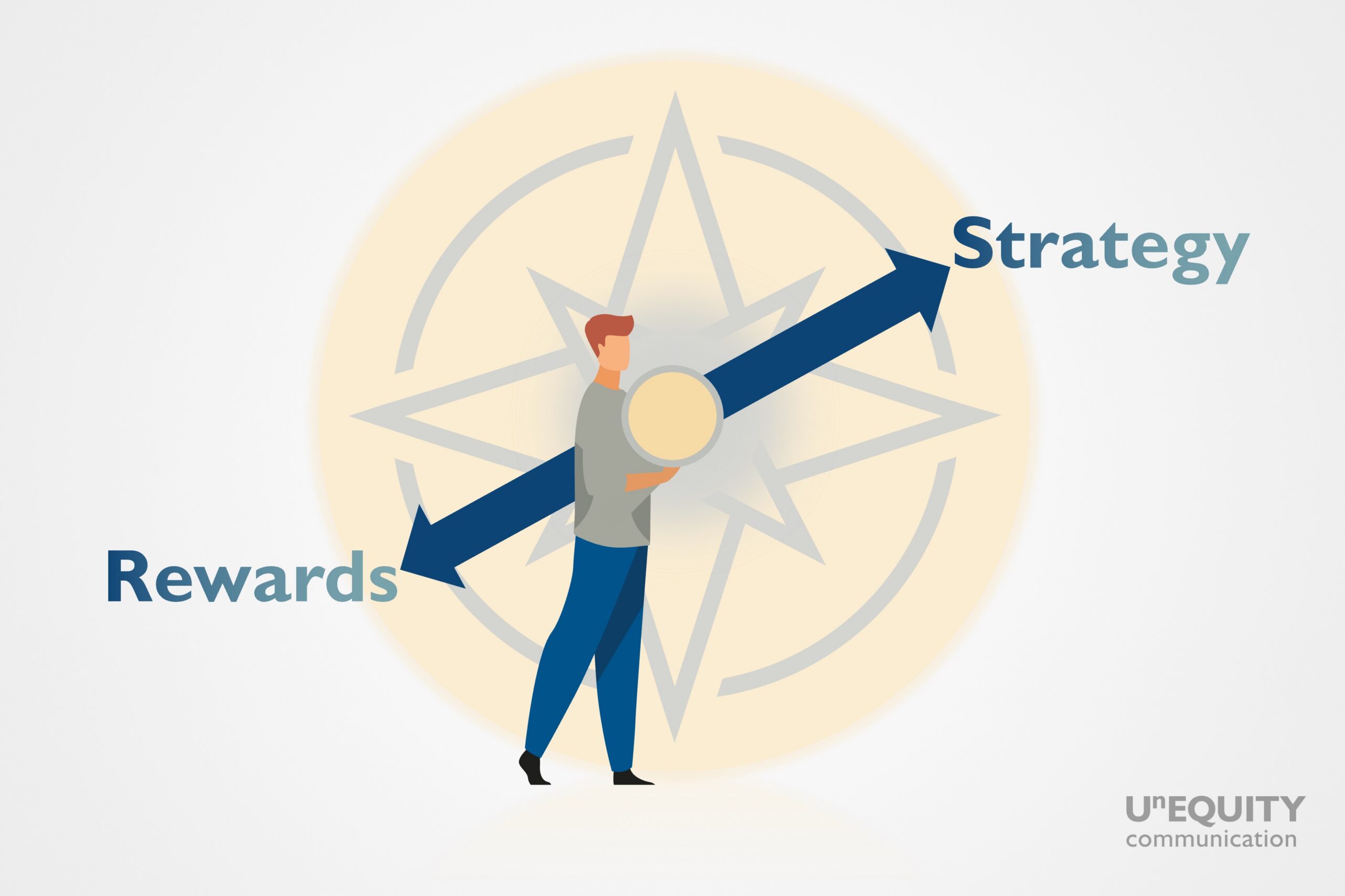
Why alignment matters
- A company announces it is moving from growth to efficiency. Its incentive plan continues to reward revenue above everything else.
- Another organization says collaboration is now critical. Individual performance still dominates the reward framework.
- A third talks about building the skills it will need for the future. People are still valued largely through job titles that reflect where they have been, rather than where the business is going.
In each case, the strategy says one thing. The reward system says another. And employees, consciously or not, tend to follow the stronger signal.
This is not a criticism of Total Rewards leaders. Most reward frameworks were thoughtfully designed to support a strategy that made sense at the time. The challenge is not poor design. It is that the world around those frameworks can change faster than the frameworks themselves. When they fall out of step, the gap rarely appears in a policy document. It shows up in behavior: in the choices people make, the priorities they pursue, and the trade-offs they make when no one is watching.
That is what makes misalignment so difficult to spot, and so consequential when it persists.
When strategy changes, what should reward do?
Not everything needs to change. A shift in business direction does not mean dismantling the reward architecture, nor should it. But it does raise a more important question:
Is Total Rewards in the room when strategy is being set, or called in afterward to translate it into a new set of targets?
That distinction matters. The question is not simply whether an incentive plan reflects the new strategy. It is whether those designing and governing reward understand the strategy well enough to recognize when the two are beginning to drift apart.
That requires a different relationship between reward and the business. Less focused on program design. More focused on what reward is actually encouraging people to do.
The test most organizations never apply
Employees do not only listen to what leaders say. They notice what gets measured, recognized, and rewarded. That makes Total Rewards one of the most powerful ways an organization communicates what matters, yet we rarely stop to examine it through that lens. So perhaps there is a simple test we could apply:
If we stopped reading the strategy document and looked only at the reward architecture, what would we conclude the organization is actually trying to achieve?
⇔Not whether the framework is competitive.
⇔ Not whether it is internally consistent.
⇔ But whether it is helping the organization become what it says it wants to become.
It is a surprisingly difficult question to answer. And perhaps that is the point.
Why this matters now
The conversations we’ve had this year have repeatedly touched on this tension. The workforce is changing. Reward systems are becoming more flexible, data-driven, and personalized. AI is exposing weaknesses in existing foundations. The playbook is becoming harder to defend. But underneath all of this sits a more fundamental question:
If Total Rewards is becoming more adaptive, what exactly are we trying to steer?
Flexibility without direction is simply optionality. And perhaps that is where the strategic role of Total Rewards becomes most interesting. The organizations that get the most from a more dynamic reward architecture may be those that first ask what their reward system is actually telling people to do. Ultimately, employees experience the organization through what they are asked to do, what is measured, what is recognized, and what is rewarded.
That makes Total Rewards more than a support function that executes strategy after the fact. It is one of the ways strategy stops being a document and starts being something people actually feel.
- This article was published on
CONTACT US
If you’d like to chat about this, or any other topic, get in touch with us.
We lead People-Projects to success through communication.

Your contact person
- simone[@]unequity.com
- +49 (0) 174 / 310 78 27
- Simone Schmitt-Schillig
Share this page directly: