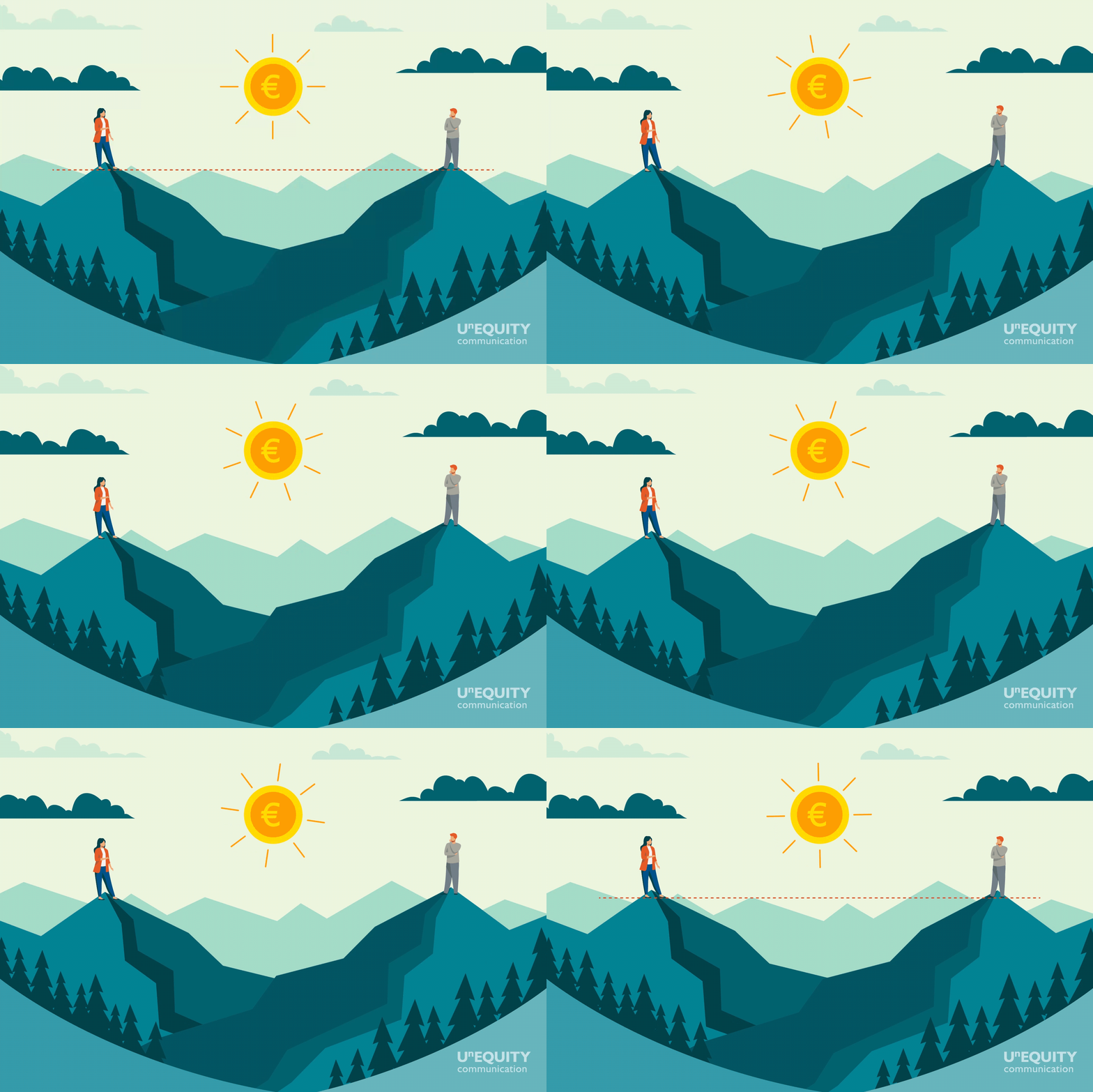
Pay transparency as an opportunity
On June 8 2026, the EU Pay Transparency Directive enters into force, requiring member states to transpose it into national law. In Germany, this is expected to happen in 2027.
Drawing on our many years of experience in Total Rewards communication, this article outlines the road ahead—and what it means for your company.
We’ll clarify key terms, provide an overview of the process, and show how we can help you put it into practice.
What it’s about—and what it’s not
Key aspects of the EU Pay Transparency Directive
The core principle of pay transparency is equal pay—equal pay for equal or equivalent work.
The provisions in detail:
- Starting in 2026, companies with more than 100 employees must prepare pay reports.
- Entry-level salaries or salary ranges must be disclosed in job postings.
- Employers are no longer allowed to ask applicants about their previous compensation.
- Companies must review their internal pay structures and report on equality and pay equity.
Clear boundaries of pay transparency:
- Existing collective bargaining agreements remain unaffected.
- Individual salaries remain confidential—only job levels and salary bands can be requested.
- Pay differences may still exist, but they must be justifiable and based on transparent criteria.
- Companies retain full control over how they structure compensation, but they must comply with equal pay for equal or equivalent work.
Five-point plan for German companies
The German government’s commission on implementing the Directive set out five key points:
- Data basis for reporting
Companies must base their reports on actual gross annual pay, including all fixed and variable components. Some components, such as severance payments or minor non-cash benefits, may be excluded in practice. Companies can decide for themselves how much detail to include when reporting variable compensation. - Employee right to information
The right to request salary information will become effective in 2027. Small comparison groups (fewer than six men or six women) are excluded for data protection reasons. Companies must clearly define and communicate the methodology used to categorize employees. - Employee categories and collective agreements
For employees covered by collective bargaining agreements, companies should distuingish between unionized and non-unionized employees to classify pay differences more accurately. The commission also recommends that companies consider using scientifically validated job evaluation tools, though this remains optional. - Group-level reporting
The commission proposes allowing companies to consolidate reports at group level, i.e., across multiple legal entities within a parent company. It’s not yet clear whether data must be reported in aggregated form only, or broken down by legal entity too. - Handling discrepancies and the gender pay gap
If unjustified differences are identified, companies are expected to promptly establish an action plan with employee representatives, including clear timelines. In practice, adjustments may take several years—for example, if collective agreements need to be amended. The commission recommends aligning these reporting obligations with other sustainability requirements, such as the Corporate Sustainability Reporting Directive (CSRD).
International companies face additional strategic adjustments, as they must align regulations and reporting standards across countries.
Key terms
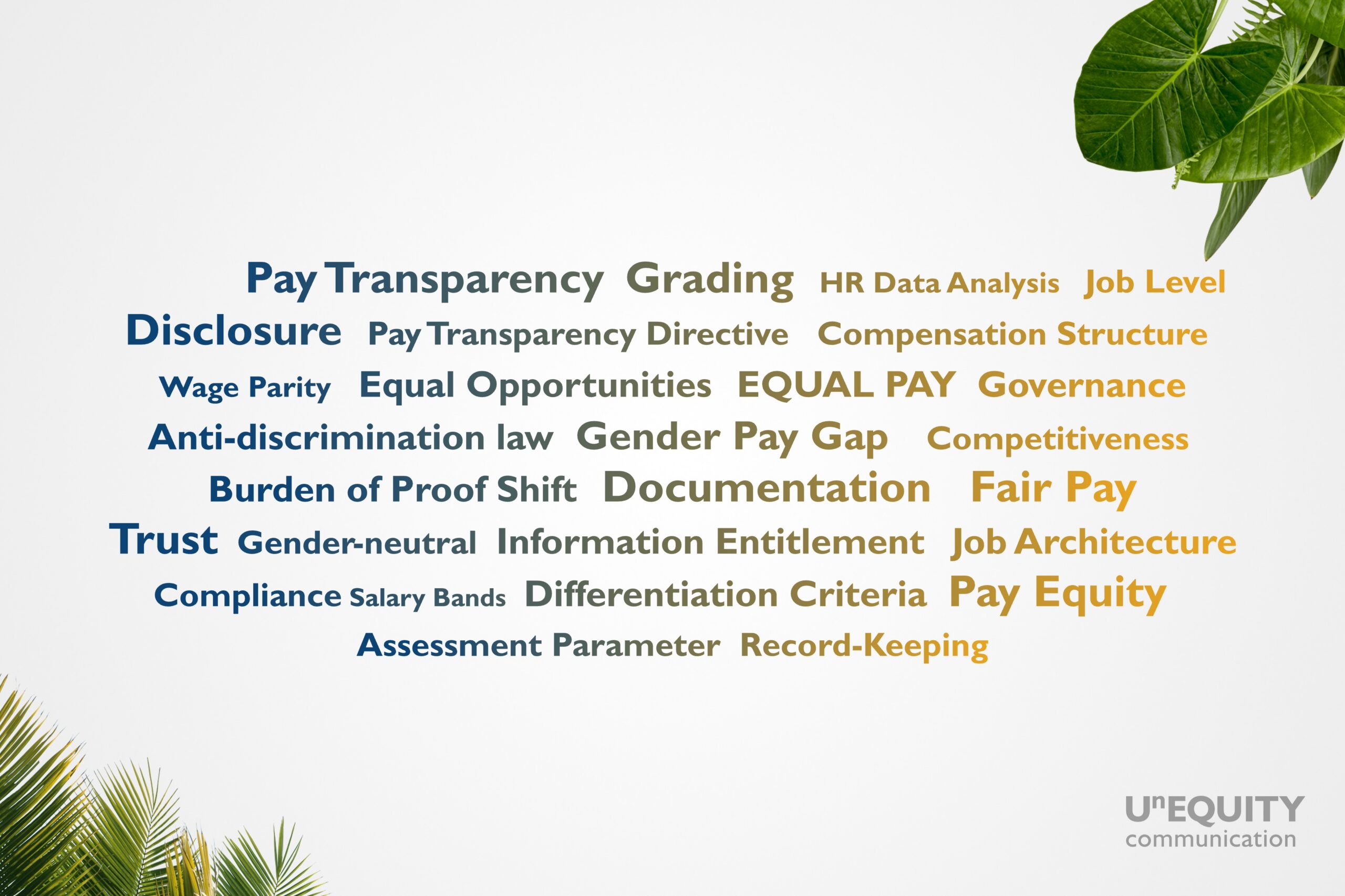
The key EU Pay Transparency Directive terms you need to know..
Creating a roadmap for successful implementation
Many companies are currently working hard to future-proof their HR structures. Our clients typically already have well-defined compensation systems, but they often lack the internal resources to communicate these frameworks clearly and consistently.
Here’s what to prioritize:
- A clear compensation philosophy
A sustainable compensation system includes consistent HR data, a well-designed job architecture, a detailed job catalog, and clearly defined salary bands. - The balance between internal and external transparency·
Compaies need to find the right level of transparency for both candidates and current employees. Depending on roles and responsibilities, leaders need to access different levels of information so that they can act confidently and make sound decisions. - Training for HR teams and managers
HR professionals and people leaders need to understand the rationale behind your pay structures, the legal requirements, and how to communicate pay decisions in a clear, consistent, and compelling way. - Regular updates and ongoing communication
Pay transparency is not a one-off project. Companies need regular reviews, updates, and ongoing communication to keep all stakeholders informed and engaged.
Our perspective
Our experience shows that integrating internal communication from the outset—and keeping employees consistently informed—builds understanding of the process and moves companies closer to their ultimate goal: pay equity.
Open, honest, and empathetic communication enables companies to address employee concerns about pay transparency while also leveraging the opportunities that higher transparency creates. This not only promotes equality but can also strengthen company culture and improve employee satisfaction.
With our expertise in Total Rewards communication, we support our clients as a strategic partner from the very beginning and guide them throughout the entire process of communication—from initial assessment and design to implementation.
Download our short guides on job architecture, equal pay, the gender pay gap, and more.
View examples of our successful client Projects in Total Rewards communication.
If you would like to explore this topic in more depth, feel free to contact us. We’ll help you take the next step toward pay transparency compliance.
- This article was published on
CONTACT US
If you’d like to chat about this, or any other topic, get in touch with us.
We lead People-Projects to success through communication.

Your contact person
- simone[@]unequity.com
- +49 (0) 174 / 310 78 27
- Simone Schmitt-Schillig
Sources:
Entgelttransparenzgesetz Federal Republic of Germany
Further information:
Bundesministerium für Familien, Senioren, Frauen und Jugend
Personalwirtschaft Artikel zum Entgelttransparenzgesetz (German only)
Kommission der Bundesregierung zur Umsetzung der EU-Richtlinie (German only)
Share this page directly: